
Dairy Water Treatment Case Study: Improved Milk Yield & Herd Health

Discover how clean water delivered measurable improvements in milk yield and herd health at a dairy farm in Cumbria.

At Dundraw Farm, recurring E. coli and mastitis cases, along with persistent bacterial contamination, continued despite regular manual trough cleaning. Water testing revealed significant bacterial build-up and biofilm throughout the farm's water system - a common but often overlooked cause of herd health issues. Intemax implemented a water treatment solution with automated dosing and remote monitoring to resolve the problem at its source.
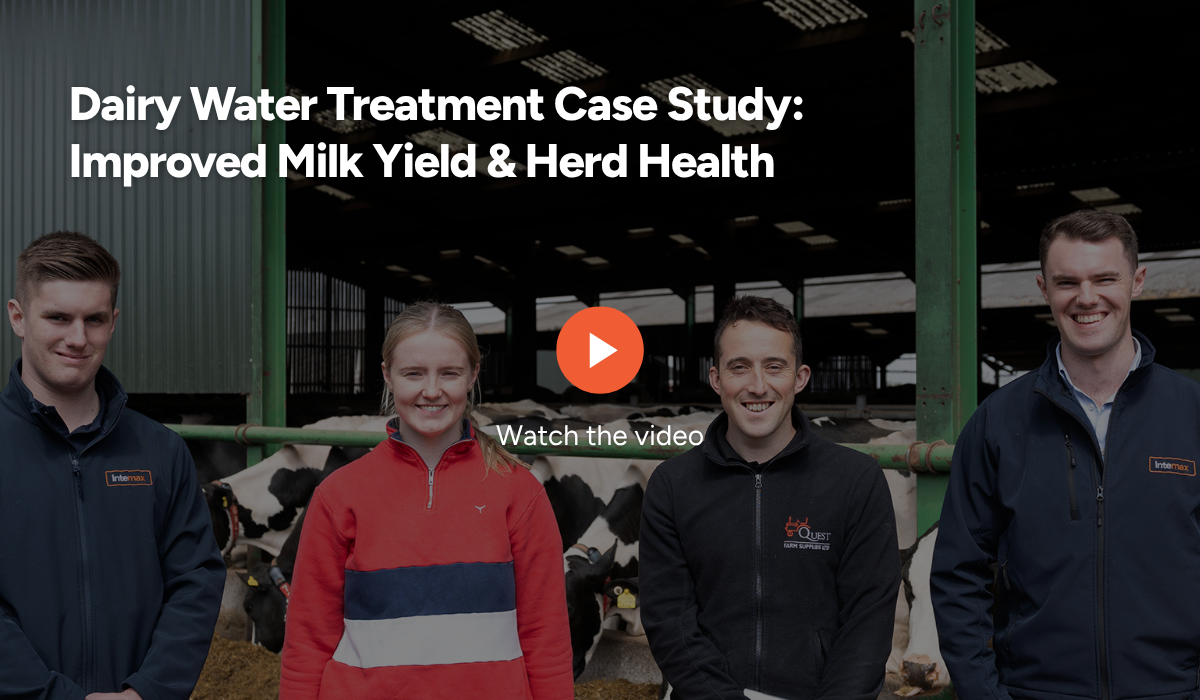
Dundraw Farm Case Study_Video

The Challenge

Despite keeping to a consistent manual cleaning schedule for water troughs, Dundraw Farm continued to see recurring E. coli mastitis cases and unresolved concerns about water hygiene. On the surface, the water looked clean — but that wasn't the full picture.

Testing showed that the most useful sample wasn't taken at the water source, but at the point where the cows actually drink. That sample told a different story: significant bacterial build-up and biofilm within the pipework and drinking system, creating conditions where harmful bacteria could keep multiplying regardless of how often the troughs were cleaned. The contamination was placing ongoing pressure on herd health and productivity, even though nothing looked visibly wrong.

"Before working with Intemax, we never tested our water. We cleaned our troughs out weekly, scrubbed them out and rolled them over once a day at least. We would have had at least ten cases a year of our higher production cows coming down with E. coli mastitis. We didn't really put two and two together blaming the water, but we knew it was a problem on our farm." - Emma Harrison, Dundraw Farm

The Solution

Working with Intemax's water hygiene specialists, the farm implemented a Huwa-San water treatment programme designed to improve hygiene right through the drinking system, not just at the surface. The programme included:

  • Comprehensive water testing and system assessment - including sampling at the drinking point, not just the source, to identify where contamination was actually occurring
  • Automated Huwa-San dosing - continuous treatment of the water supply to control bacteria and biofilm at the source
  • Remote monitoring and ongoing support - real-time oversight to keep water quality consistent without relying on manual checks

By treating the whole system rather than just cleaning visible surfaces, water quality at the point of consumption improved significantly.

The Results

Following the changes, Dundraw Farm reported measurable improvements across intake, yield and herd health:

  • Water intake up ~10% - daily consumption rose, helping support higher production
  • Milk yield up 1.3 litres/day - average increase for high-producing cows
  • Lower bacterial and somatic cell counts - a direct sign of improved water and udder hygiene
  • Reduced immune system stress - less energy spent fighting a constant low-level bacterial challenge
  • Improved fertility performance
  • Increased butterfat levels

"I would have probably overlooked water as being such an important nutrient. Being able to remove that bacterial stress on the cows on a daily basis has allowed the cows to express a much higher level of health and production than we would have seen previously. I would highly recommend everyone at least try and test their water." — Michael Duncan, Quest Nutrition

Why Water Quality Matters for Herd Health

Water is often called the most important nutrient in a dairy cow's diet, yet it's one of the most overlooked. Feed, housing and health plans usually get close attention - water quality frequently doesn't, even though hidden problems in the drinking system can quietly undermine herd performance.

As Dundraw Farm's experience shows, regular trough cleaning alone doesn't guarantee clean water. Biofilm and bacterial contamination can persist throughout the pipework, and the most representative test sample often needs to be taken from the drinking point itself, not the source. Addressing water quality at the system level — rather than just the visible surfaces — can deliver measurable gains in intake, yield, fertility and overall herd health.

If your herd isn't performing as expected and the cause isn't obvious, it may be worth asking: when did you last test your water?

Our Water Treatment package, including automated dosing systems and filtration equipment, can help identify and resolve hidden water quality issues on your farm.

Contact our team to arrange a free water quality assessment.