
Dairy Water Quality & Treatment: Why It Matters and How to Improve It

Unrestricted access to clean water is fundamental to a healthy, productive dairy cow. Water supports digestion, temperature regulation, stress reduction, and milk production - but it can just as easily carry bacteria that undermines all of it. Poor water quality doesn't stop at the trough either: it affects parlour hygiene too, which has a direct knock-on effect for the business.

Whether your farm's water comes from a borehole or the mains, water quality is critical. Borehole water often needs treatment to deal with properties drawn from the surrounding ground and seasonal variation. Mains water is pure at the point of delivery, but becomes vulnerable to contamination the moment it starts moving around the farm - through pipework, storage tanks, troughs, and drinkers.
Comparing Water Treatment Methods

Not all water treatment chemicals perform equally. Effectiveness varies significantly across the criteria that actually matter on a working dairy farm - corrosiveness, stability, biofilm control, taste, and ease of dosing.

Note: ratings below are based on Intemax's own product comparison and reflect performance of Huwa-San TR-50 versus alternative treatment methods.

CriteriaUVChlorineChlorine DioxideUnstabilised Hydrogen PeroxideHuwa-San TR-50 Stabilised Hydrogen Peroxide
Corrosive in useOutstandingPoorPoorOutstandingOutstanding
Effective in all pH conditionsOutstandingPoorOutstandingOutstandingOutstanding
Effective against biofilmPoorPoorPoorAverageOutstanding
Stable in waterPoorPoorPoorPoorOutstanding
OdourlessOutstandingPoorAverageOutstandingOutstanding
TastelessOutstandingPoorAverageOutstandingOutstanding
No harmful residuesOutstandingAverageAverageOutstandingOutstanding
BiodegradableOutstandingPoorPoorOutstandingOutstanding
Simple to dose (no measuring or mixing)OutstandingPoorPoorOutstandingOutstanding

Performance rating: Poor – Average – Outstanding.

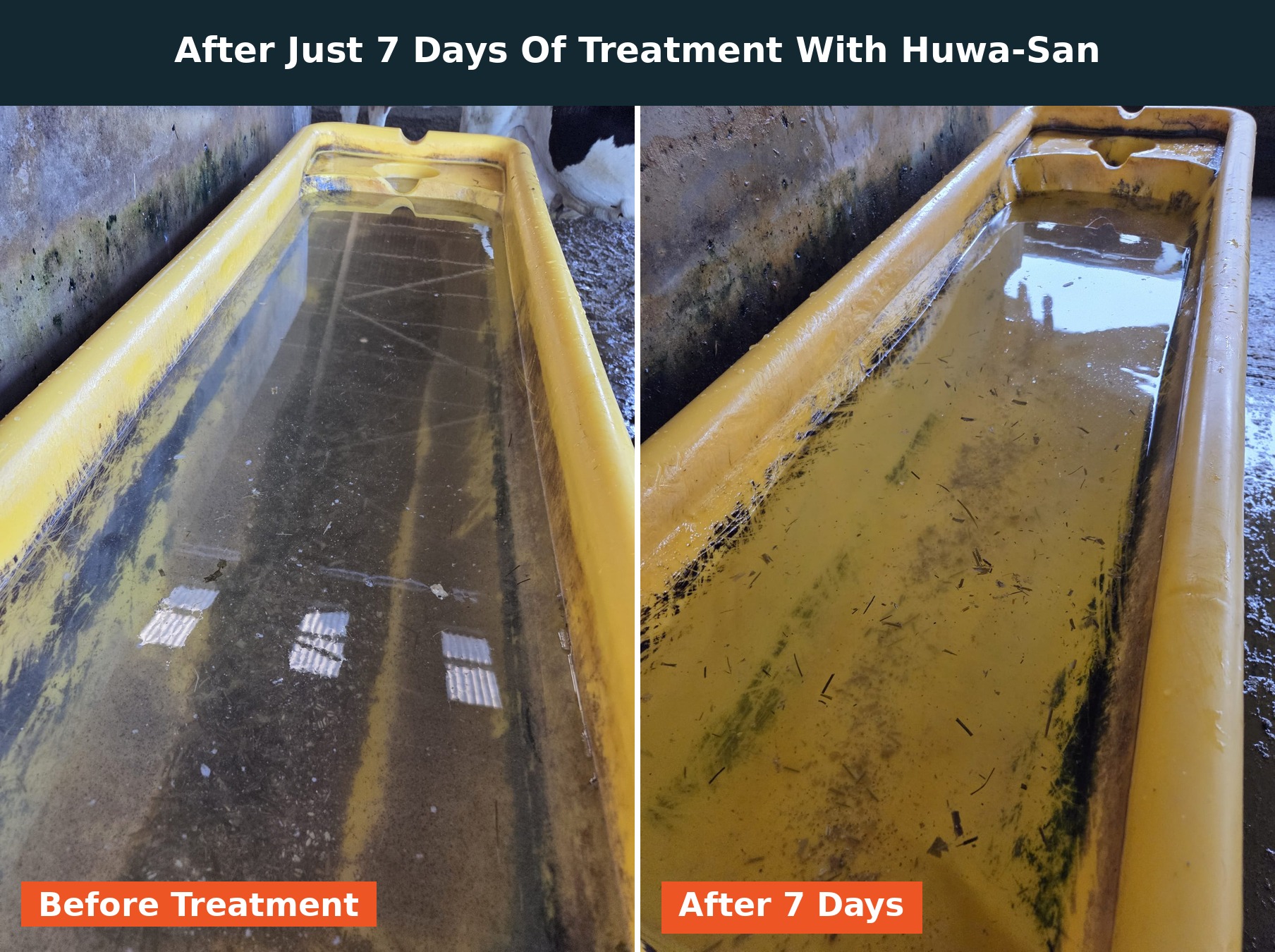
Some clear patterns emerge from this comparison. Chlorine rates poorly on nearly every measure that matters for dairy use — it's corrosive, affects taste and odour, breaks down quickly in water, and offers only average protection against harmful residues. Chlorine dioxide improves on pH performance but is still poor for biofilm control and water stability, and only rates "average" for odour and taste. UV treatment performs well while water passes through the UV unit, but is poor against biofilm and doesn't remain stable once water leaves the treatment point, meaning downstream pipework and troughs get no ongoing protection. Unstabilised hydrogen peroxide performs reasonably well on many counts but is poor for water stability and only average against biofilm, since it breaks down before reaching the furthest parts of the system. Huwa-San TR-50 silver stabilised hydrogen peroxide is the only treatment rated "Outstanding" across every single criteria — including biofilm control and water stability, the two areas where every other method falls short.

Across every one of these performance criteria, Huwa-San stabilised hydrogen peroxide delivers the most dependable results for clean water on dairy farms.

System Choices: Central Treatment vs Treatment at Each Shed

Getting the chemical right is only half the equation — system set-up matters just as much:

  • Central treatment at the pump shed is simpler and less expensive to set up initially, since it involves less equipment and lets you carry out all treatment in one place.
  • Treatment at the entrance to each shed involves a more expensive and complex set-up, but gives you far greater flexibility and control over water quality at each individual location.

The right choice depends on your farm's layout, herd size, and how much variation there is in water quality across different sheds.

The Four Pillars of Effective Water Treatment

A properly designed water treatment programme covers four key areas:

  • Filtration - removing sediment and organic matter
  • Disinfection - eliminating harmful microbes
  • Mineral and pH balancing - improving taste and milk quality while reducing scaling
  • Routine monitoring - ensuring consistent water quality across the seasons
Why Water Treatment Could Be the Missing Link in Your Dairy Herd's Performance_Section5

What a Free Site Survey Involves

Before recommending any treatment plan, a proper assessment starts with a free site survey. This typically includes:

  • A full farm walkthrough to assess your water source and current system set-up
  • Bacterial water sampling
  • Endoscope inspections of your water lines, giving a live view of internal cleanliness - including any biofilm build-up that wouldn't be visible from outside the pipe
  • A full written report and tailored proposal detailing recommended improvements
  • Finance options where new equipment is required

This is particularly useful for farms weighing up whether to switch from mains to a borehole supply, or wondering whether water is genuinely clean at every tap, trough, and tank on the farm.

Why Water Treatment Could Be the Missing Link in Your Dairy Herd's Performance_Section6

The Benefits of Water Treatment in the Dairy Setting

Cleaner water delivers measurable benefits across the farm:

  • Improves milk quality by reducing bacterial load, helping maintain consistent hygiene and lower bacto-scan levels
  • Enhances cow health through improved gut health, reduced infections, and better hydration
  • Boosts milk yield and lifetime production through peak herd health
  • Protects equipment from corrosion and mineral build-up, which otherwise makes effective cleaning harder to achieve
  • Supports a cost-effective switch to borehole water, without compromising on water quality

Ongoing Support: More Than Just a One-Off Fix

Water treatment isn't a "set and forget" job - water quality shifts with the seasons, herd size, and system wear. A comprehensive water management service should include:

  • On-site support included with every Huwa-San supply package
  • Remote monitoring as an optional add-on, tracking dosing and system performance
  • At least two analysis visits per year to fine-tune water quality
  • Detailed reports within 24 hours of each visit, including photo evidence
  • Emergency call-outs in response to issues you identify, or alerts from remote monitoring
  • Shock treatment support for the water system when required

Frequently Asked Questions

How do I know if my dairy farm's water is contaminated? Contamination often isn't visible to the naked eye. The clearest signs are reduced water intake by the herd, a rising bacto-scan or somatic cell count in milk, recurring digestive upsets or scours (especially in calves), and visible scaling or slime inside troughs and pipework. A bacterial water sample and an endoscope inspection of the water lines — both part of a free site survey — will confirm what's happening inside the system, even where nothing looks wrong from the outside.

What's the difference between borehole and mains water treatment? Borehole water usually needs treatment for properties drawn from the surrounding ground, such as minerals, iron, or naturally occurring bacteria, and this can vary with the seasons. Mains water is pure at the point of delivery, but becomes vulnerable to contamination as soon as it starts moving through farm pipework, storage tanks, and troughs. Both water sources benefit from treatment — just for different reasons.

How often should dairy farm water be tested and treated? As a minimum, water quality should be professionally assessed and fine-tuned at least twice a year, since water quality shifts with the seasons and system wear. Continuous treatment (rather than one-off testing) is what maintains water quality between visits, with remote monitoring able to flag issues as they arise rather than waiting for the next scheduled check.

Why is Huwa-San preferred over chlorine or UV treatment? Huwa-San is a stabilised hydrogen peroxide treatment that remains effective across all pH conditions, is stable in water, and is effective against biofilm — while being odourless, tasteless, non-corrosive, and leaving no harmful residues. Many alternative methods, such as UV or chlorine, are limited in one or more of these areas: UV doesn't treat water once it leaves the treatment point, chlorine can taint taste and corrode equipment, and unstabilised hydrogen peroxide loses effectiveness before it reaches the furthest trough.

Does water treatment actually improve milk yield? Yes. Cleaner water supports better hydration, digestion, and gut health, all of which feed through into peak herd health and, in turn, milk yield and lifetime production. It also helps maintain consistent hygiene and lower bacto-scan levels, directly supporting milk quality.

What does a free water treatment site survey involve? A site survey includes a full farm walkthrough, bacterial water sampling, and an endoscope inspection of your water lines to check for biofilm and internal cleanliness. You'll receive a full written report and tailored proposal afterwards, including finance options if new equipment is recommended.

Effective water treatment is one of the most impactful upgrades you can make to boost dairy farm performance - supporting milk quality, herd health, and equipment longevity, all from one investment.

Explore our full Dairy Water Treatment brochure or call +44 (0)1246 264646 to book your free site survey.


Want tailored advice for your farm? Contact the Intemax team to discuss a water treatment plan suited to your herd, your water source, and your system layout.